This work is a declaration of love for nature and its creatures, a hymn to its beauty, a lament for the loss of nature and species caused by the biodiversity crisis, and a cry of anger at the fact that we humans are largely responsible for this crisis and are doing far too little to counter it. Each movement of the work is inspired by one or more organisms, which at the same time stand for a broader philosophical idea. Listen to each movement here:
I. Volvox
Volvox is a tiny alga, a spherical colony of cells. Within this sphere—the so-called “mother colony”—new colonies grow: the daughter colonies. When these become too numerous and too large, they cause the mother colony to burst. The mother colony dies, and the daughter colonies become new mother colonies. Volvox thus also symbolically represents the emergence of the first life in water and the eternal cycle of life. Like Volvox, the music consists of tiny cells—small motifs that grow and multiply. The woodwinds in particular represent the various daughter colonies developing within the “mother colony,” that is, the orchestra itself, eventually causing the whole to burst apart. Moreover, the music imitates the rolling motion of Volvox and celebrates its at times mesmerising beauty and at times bizarre way of life, as revealed under the microscope (Volvox means “the roller” in Latin).
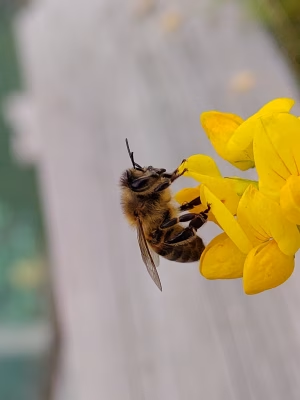
II. CCD – La mort des abeilles
CCD stands for Colony Collapse Disorder, the disappearance of entire bee colonies. “La mort des abeilles” (The Death of the Bees) is an allusion to the wonderful and poetic book La vie des abeilles (The Life of the Bees) by Maurice Maeterlinck, published in 1901. The death of the bees stands here as a symbol for the destruction of nature and our world. The movement is an apocalyptic vision of a future barren and inhospitable Earth from which most life has vanished, as well as a lament sung by a departed soul visiting its former home.
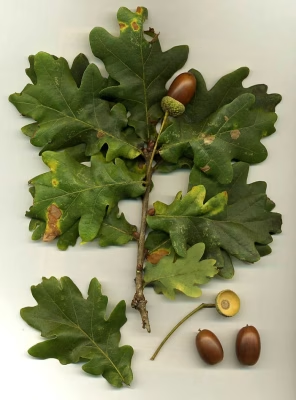
III. Dervonemeton
Among the Celts, a nemeton was a sacred place, particularly a sacred grove. Dervonemeton is the reconstructed Gaulish word for “sacred oak grove.” The oak held a special cultic significance for the Celts. This movement expresses the sense of the mystical and the spiritual that we can experience in nature. The oak is my favorite tree. I am anything but a religious person and often find man-made gods boring or irritating; yet when I stand before an oak that is several hundred years old, I feel an extraordinary sense of reverence and spirituality. Also woven into the music is the call of the red kite, one of my favorite birds, whose voice has a very distinctive, flute-like quality.
IV. Balaena mysticetus
Photograph: Kelvin Aitken/VWPics/Alamy
Balaena mysticetus is the Latin name of the bowhead whale, one of the most beautiful and majestic animals on our planet and at the same time a genetic superhero: the bowhead whale is genetically immune to cancer and can live for more than 200 years. It is the longest-living of all mammals. This movement is inspired by the many sounds of the sea, as well as by the fascinating visual presence of a gigantic whale. Also woven into the music is the cry of a much misunderstood bird for which I feel a particular sympathy and whose endangered status is unknown to many: the seagull. This movement is a hymn to the beauty of nature and its creatures. With its longevity and genetic immunity, the bowhead whale stands as a symbol of resilience and hope. Humans have driven all large whale species to the brink of extinction, yet managed to avert the final catastrophe just in time. May humanity also grow wiser in time with regard to climate change, mass extinction, and other ecological catastrophes than we are today.
Second movement “Gloria” from “Messe für Muri” (Including poems by William Blake and Georg Trakl)
Videos
Watch a selection of performances and recordings below.